Thoughts on Tango Teaching | Part 63
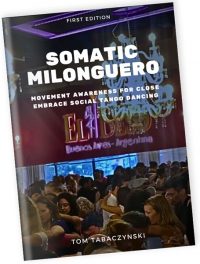
Somatic Milonguero by Tom Tabaczynski – Is Teaching Unnecessary, or Does It Need to Be Fundamentally Different?
Preliminary Note
Tom Tabaczynski originally asked me himself whether I would review Somatic Milonguero. Given my own experience with alternative approaches to learning and movement, he apparently initially considered me a suitable author. During the course of our exchange, however, I raised a number of critical questions about his model. After that, he decided no longer to regard my contribution as the review he was looking for and approached other authors or blogs instead.
In the meantime, a guest article by him has appeared on another blog. This could create the impression that the following text is a response to that article. It is not. I have been working intensively on this article for four days; it grew out of my earlier engagement with Somatic Milonguero and from our exchange.
Precisely because I have spent more time examining the underlying questions critically, what finally emerged is not a conventional book review, but a much more extensive contribution to my series “Thoughts on Tango Teaching.”
Tom Tabaczynski begins Somatic Milonguero with a fundamental critique of what he calls “tango classero”: a teaching system in which tango is learned through prescribed steps, figures, techniques, embellishments, and their repeated practice. In his view, this model does not lead to the improvised and adaptive tango he observed in the crowded downtown milongas of Buenos Aires. Even teaching that explicitly calls itself “Tango Milonguero” often remains, in his eyes, merely tango classero in close embrace.
His reflections begin with his own experience in these milongas. Because of the lack of space, he had to abandon large movements, prepared sequences, and much of what he had previously learned in lessons. Instead, he had to “do less”, be ready to stop or change direction at any moment, and continuously adapt his movement to his partner, the music, and the available space. From this, he develops the idea that the movements of experienced milongueros should not be understood as fixed techniques, but as the result of a long process of adaptation and improvisation.
As an alternative to conventional teaching, Tabaczynsky draws on somatic movement education, particularly F. M. Alexander, Feldenkrais, Steve Paxton’s Contact Improvisation, and Material for the Spine. Somatics focuses less on the externally visible form of a movement and more on its internal organization: balance, weight, muscular tension, skeletal organization, movement flow, and perception. Tabaczynsky describes his own experience with Contact Improvisation as crucial in helping him move beyond the movement patterns he had learned in tango classes and dance more spontaneously.
He connects this with a fundamental critique of learning through imitation. Improvisation, he argues, can ultimately emerge only when learners generate movement themselves and adapt to changing partners and situations. Teaching, by contrast, easily creates the impression that the movement demonstrated by the teacher is the correct solution. In Tabaczynsky’s view, a beginner therefore needs at most a small number of basic movement possibilities; a richer repertoire should then emerge spontaneously through social dancing.
In the historical chapters, Tabaczynsky also argues that many ideas about “authentic” tango movements are not reliably supported by historical evidence. Steps such as the paso básico, cruzada, or ocho may be less original elements of a clearly defined tango than movements later systematized and stylized for performance and teaching. He therefore examines the history of Western partner dances and early tango manuals in order to question conventional narratives about tango’s origins and traditions.
Another central foundation of the book is Stephen Krashen’s theory of language acquisition. Tabaczynsky compares conventional dance teaching with Krashen’s so-called skill-building model: a teacher presents forms, the learner reproduces them, practises them, and is corrected. Krashen contrasts this with comprehensible, meaningful input. Tabaczynsky transfers this idea to tango: rather than practising correct forms, he sees social context, music, observation, interaction, and actual dancing as the essential sources of learning.
Motivation, low anxiety, and the so-called silent period also play a role: learning may already be taking place before visible performance appears. The milonga thus becomes the main learning environment. Tabaczynsky even suggests that the physical constraints of a crowded dance floor may help develop more efficient, spontaneous, and connected movement.
The final chapter turns to practice. Tabaczynsky describes exercises for awareness of the pelvis, spine, centre of mass, and movement organization, including exercises inspired by Aikido and Paxton. He concludes by referring to a short Movement Release for Tango Milonguero practice.
The central thesis of the book can therefore be summarized roughly as follows: Tango Milonguero does not emerge through increasingly precise mastery of prescribed forms, but through somatic awareness, improvisation, and adaptation within the social context of the milonga. Teaching may help initiate this process, but when it becomes a permanent system of technique, figures, practice, and correction, Tabaczynsky believes it is more likely to obstruct than to support it.
This obviously lengthy article is not a conventional book review. Somatic Milonguero by Tom Tabaczynski is, for me, an opportunity to reconsider some fundamental questions about tango teaching. Much in this book touches on subjects I have been thinking about for decades. Some of it confirms experiences I have had in my own teaching, other parts have provoked disagreement, and on some points I changed my mind several times while reading. I therefore want less to evaluate the book than to examine its theses in the light of my own experience with tango, learning, and teaching.
I want to make one thing clear from the outset: I consider a substantial part of Tabaczynski’s criticism of common tango teaching to be justified. Overloading students with figures, the idea that progress consists mainly in acquiring ever more movements, the mechanical repetition of external forms, and the attempt to have a stored solution ready for every dancing situation — I have considered all of this problematic for a long time. I also share the view that people need more time to perceive for themselves, discover differences, experiment, and find their own solutions.
That is precisely why the book has occupied me so much. Starting from observations with which I often agree, Tabaczynski draws conclusions that I increasingly find difficult to follow.
Tango Is More Than a Dance Technique
To understand Tabaczynski’s argument, it should not be read merely as a criticism of particular teaching methods. Something larger lies behind it: tango appears in his thinking as a cultural system. How people dance therefore depends not only on which movements a teacher shows them. The entire environment matters: what music they hear, which dancers they observe, what ideas about tango prevail around them, how a milonga is organized, how much space is available on the dance floor, which movements are accepted there, and which social rules determine behaviour.
I consider this thought very important. Teaching never exists outside a culture. If, for years, a tango scene mainly teaches figures, spectacular movements, external body images, and ever more levels of progression, it will produce different dancers from an environment in which music, social responsibility, perception of the partner, and adaptation to the actual situation are more important.
Tabaczynski accordingly describes his own experience in the crowded downtown milongas of Buenos Aires as a process of doing less. Large movements and stored sequences proved of little use there; the situation demanded smaller solutions, constant readiness to adapt, and attention to partner, music, and available space.
One of his strongest ideas, for me, is therefore the distinction between product and process. The visible movements of experienced milongueros are not necessarily a technique that can be isolated and then handed back to other people. They may instead be the result of years of adaptation, exploration, musical experience, and individual development.
A dancer does something. An observer sees the movement, breaks it down, names it, and then begins to teach it as a technique. There is a genuine danger here of confusing the product of a learning process with the learning process itself. A movement shows very well what something looks like. It does not automatically show why it came into being that way.
Teté Rusconi – Dancing from the Organization of the Couple
While reading Somatic Milonguero, I repeatedly found myself thinking of Teté Rusconi†, whom I had the opportunity to experience myself. For me, Teté was a particularly vivid example of how contextual dancing can work. At the same time, he also showed why it can be so difficult to translate such dancing into conventional forms of teaching. When dancers wanted to know from him how a particular movement worked, he quite often ended up with “rhythm and feeling.” That could be extremely frustrating, because the visible movement was very concrete, while his explanation offered hardly any reproducible instructions.
Over time, it became clearer to me that Teté apparently did not organize his dancing primarily through his own step sequences at all. In the close embrace, both partners leaned into one another and thereby created a shared balance. This balance was not a static condition, but had to be continuously maintained and reorganized while dancing. In very practical terms, this also meant that Teté had to make sure his partner did not fall over. As soon as she shifted her weight, changed her position, or the situation on the dance floor demanded a different direction, he had to adapt his own movement accordingly.
His own step therefore did not stand at the beginning of the organization. Rather, it emerged as a consequence of what was happening with his partner and with the couple as a whole. Teté set his partner in motion, perceived how she actually moved, and then organized his own position so that shared balance, direction, and musical coherence were maintained. In such an understanding, the leader may give an impulse or open up a movement possibility, but his own next step is not fully predetermined. It also arises from what the follower actually does with that impulse.
This, to me, marks a decisive difference from a widespread way of dancing in which the leader defines himself primarily through his own step patterns. He has a rough idea of the movement he wants to execute and then tries to lead his partner through this already imagined pattern. The partner can easily become part of his own movement plan. That can work, but it carries the danger of becoming a pattern prison: familiar sequences increasingly determine which possibilities are perceived at all. The dancer may combine ever more stored elements, but the actual situation becomes less important.
This can in turn produce the very dancing stagnation that later creates a demand for ever more new figures. One looks for the solution to one’s boredom in further patterns, even though attachment to patterns may itself have caused the problem. An odd cycle emerges: The pattern creates stagnation — and stagnation creates the demand for new patterns.
Teté’s dancing points towards a different organization. The central question is not, “Which step am I going to do now?” but rather: “What is happening with my partner right now, and what movement follows from that for me?”
The step did not organize the couple. The movement of his partner and their shared balance organized Teté’s next step.
Although Teté Rusconi (here with Rosanna Remon) was unable to reproduce a particular step in class, his movement patterns are nevertheless very familiar to us today. Teté was a typical milonguero, a self-taught dancer — so are we really to assume that his entire style emerged without any models or guidance, solely from his own creative process through trial and error?
Conditional Learning – One of the Strongest Ideas in the Book
I found Tabaczynski’s discussion of conditional learning particularly interesting. It makes a considerable difference whether I tell a student, “This is the correct way,” or, “Under these conditions, this may be one possible solution.”
This corresponds very strongly with my own teaching experience. One essential principle of my teaching is learning through differentiation. I do not merely want to show a student how something is supposedly done correctly. I want to make differences perceptible. What happens with more pressure? What changes with less? When do I open a path for my partner, and when do I block it? How does a shared movement change when weight, orientation, or position are organized differently?
From this follows a sentence that probably describes one of the core ideas of my teaching:
You can define a task without prescribing its solution.
And this is precisely where my real difference with Tabaczynsky begins.
Is Teaching the Problem – or a Particular Form of Teaching?
Tabaczynski criticizes a model of teaching that can be summarized roughly as follows: the teacher demonstrates, the student reproduces, the teacher corrects, the student repeats. More and more movements are added and eventually automated.
If this is what is meant by tango teaching, I largely agree with his criticism.
But is this really teaching itself?
A teacher can do something entirely different. He can create a situation, make a difference perceptible, ask a question, change one variable, or help a student perceive the cause of a problem in the first place. He can organize a learning task without predetermining its outcome.
The teacher then ceases to be a supplier of ready-made solutions and becomes an organizer of a learning process.
For precisely this reason, Tabaczynsky’s conclusion seems too far-reaching to me. A justified criticism of overloaded, form-oriented teaching develops into a fundamental scepticism towards teaching itself. Yet even the somatic approaches he draws upon show that guidance and exploration are by no means opposites. Attention can be directed, a task can be set, and an experience can be made possible without prescribing the outcome.
Less Teaching or Less New Material?
Students are often curious and positively hungry for something new. New movements are enjoyable, create variety, and give a sense of progress. The problem begins when this hunger is constantly fed with new material.
A new figure is exciting. Re-examining a supposedly familiar movement under different conditions, varying it, and really exploring it in depth is much harder work. Yet that may be precisely where the more important learning takes place.
For this reason, I am not convinced by a simple opposition between more and less teaching. A weekend workshop can contain so much input within a few hours that a large proportion of it has disappeared again only a few days later. Fewer teaching sessions do not automatically mean less overload.
I can, by contrast, easily imagine regular teaching sessions in which almost no new material is introduced. Students dance, experiment, encounter problems, and increasingly bring their own questions. The teacher does not constantly provide new answers, but helps them investigate their questions more effectively.
Perhaps we should therefore distinguish less between more and less teaching than between more and less unnecessary input.
Krashen and the Idea of Learning Through Input
One of the book’s central theoretical foundations is Stephen Krashen’s model of language acquisition. Put very simply, learning in this model takes place primarily through comprehensible, meaningful, context-related input. Tabaczynsky transfers this idea to tango and contrasts it with the conventional model of explanation, production, practice, and correction.
The idea is stimulating. Tango does indeed have something language-like about it. Two people communicate with one another, respond to one another, and develop movement within a shared system.
The question, however, is how far the analogy can be taken. Tango is also a complex sensorimotor process involving two physically connected bodies. As soon as a beginner dances, his movement produces a reaction in his partner; that reaction in turn changes his own behaviour. Learning therefore does not take place solely through the reception of external input, but within a continuous feedback loop between two acting human beings.
This is precisely why problems can arise whose causes are not at all obvious to beginners. Both partners may experience a movement as uncomfortable or unstable without being able to identify what actually caused the problem.
An error does not automatically contain its own explanation.
The “Silent Period” – and What Is Actually Being Observed
Krashen’s model also includes the so-called silent period: learning may already be taking place even though little outward production is visible. People listen to a language, observe relationships and patterns, and only later begin to speak themselves.
Tabaczynsky transfers this idea to Buenos Aires. A person there may hear tango music, experience milongas, and observe social processes long before beginning to dance seriously. I find that plausible.
But perhaps this silent phase describes less a pedagogical method than a cultural head start. Someone living within a tango culture can absorb such information almost incidentally over a period of years. For an adult interested in tango in Germany or Australia, a comparable situation would have to be artificially created.
Above all, however, something is overlooked in this idea: someone observing dancers during a “silent learning period” does not merely absorb abstract context.
He sees movements.
Buenos Aires Also Has a Shared Movement Repertoire
A milonga in Buenos Aires is not an open movement space in which every person reinvents tango entirely from within his own body. Like every social dance, tango has a historically evolved shared pool of possible movements and forms of organization. Certain weight changes, ochos, crosses, turns, openings, transitions, and spatial relationships appear again and again. Dancers recognize them, observe them, and adopt them.
The systematic investigations of Gustavo Naveira, Fabián Salas, and later Mariano “Chicho” Frúmboli in particular have shown that tango contains structural possibilities that can be analysed, combined, and expanded. This does not mean that tango consists of a closed catalogue of figures. But it certainly shows that improvisation takes place within a culturally existing movement space.
These movements themselves emerged at some point from concrete situations involving the couple, space, and music. They may therefore indeed be products of earlier processes of adaptation. But once these products become part of a culture, they in turn become input for the next generation.
This complicates the distinction between product and process.
The beginner at a milonga does not merely observe people moving “naturally.” He sees culturally shaped movements, recognizes repetitions, and may begin to imitate them.
Imitation does not disappear when the teacher disappears.
The product already exists before the beginner has found his own somatic solution.
Perhaps tango is therefore better understood as a cycle: earlier dancers find solutions for concrete situations. These solutions become part of the culture. Other people observe and adopt them. Through new bodies, partners, music, and spatial conditions they are modified. New variations emerge and in turn enter the cultural pool.
Tango would then be neither a fixed vocabulary nor pure spontaneous self-organization, but a culturally transmitted and continuously changing movement repertoire.
A realistic look at an idealized scenario…
The Milonga Corrects as Well
This shared movement space is by no means value-neutral. A traditional milonga has not only códigos in the narrower sense, but also expectations about what tango should look and feel like. Someone who moves far outside the commonly accepted forms may be perceived as inappropriate or disruptive and may have difficulty finding partners.
The context is therefore not only liberating and creative, but also selective. Certain solutions receive social acceptance; others receive less.
The milonga corrects too — just not necessarily through a teacher.
There is also an aesthetic dimension. Dancers observe one another. They see musicality, calmness, elegance, expression, embrace, and quality of movement. These perceptions also influence whom they later want to dance with. Partner rotation in particular makes such aesthetic evaluations into a powerful social learning mechanism.
A milonga therefore communicates not only: “This is how you can adapt spatially.” It also communicates: “This is what attractive or acceptable tango looks like within this community.”
Certain solutions are admired, copied, and socially rewarded. Others remain marginal.
The teacher disappears, but the norm does not. It is simply communicated differently.
Shared Forms and Somatic Adaptability Are Not Contradictions
This certainly does not mean that dancers in Buenos Aires merely reproduce a shared repertoire of figures. On the contrary, I consider the ability of many experienced dancers to respond to the smallest changes in their partner within the close embrace one of the great qualities of this dance culture.
A social dance always requires shared forms. Without a culturally shared movement space, spontaneous dancing with changing partners would hardly be possible.
The decisive difference therefore lies not between movement vocabulary and freedom, but in how that vocabulary is used.
Especially in the close embrace, the external movement form often recedes into the background. What becomes decisive is the bodily sensation within the couple: How is our shared weight organized? Which direction is possible now? How much movement is actually necessary? What changes when the partner responds differently than expected?
In this I see one of the great strengths of this tango.
But the crucial sentence, for me, is this:
It is not the absence of a shared movement vocabulary that makes this tango adaptive, but the ability to reorganize that vocabulary within the couple again and again.
Or, more generally:
What characterizes the tango of Buenos Aires is not an absence of cultural conventions, but the flexible way in which they are handled.
If Buenos Aires is to serve as Tabaczynsky’s reference model, then the whole dance culture there should be considered — not only those characteristics that fit particularly well with his theory. That includes not only somatic adaptation, closeness, and contextual learning, but also transmission, imitation, shared movement forms, aesthetic norms, and social selection.
Can Buenos Aires Be Transplanted?
A traditional milonga in Buenos Aires is not simply a room with traditional music, limited space, and certain rules. It is part of a historically evolved social system. People bring listening habits, experiences, expectations, role models, and an understanding of what this space actually means.
If, in Germany or Australia, you reduce teaching, play traditional music, and make the dance floor more crowded, you do not thereby create Buenos Aires.
At first, what you get is people who have had less teaching.
But not yet a mature tango culture.
A learning culture cannot simply be dug up like a plant and transplanted into different cultural soil.
Anyone wishing to reproduce the learning conditions of Buenos Aires would have to transfer far more than floor density and music: social motivation, aesthetic expectations, movement culture, role models, changing partners, social conventions, and in some cases years of prior cultural experience.
A culture is more than the sum of the conditions one would like to create.
Trial and Error – but Under What Conditions?
Trial and error is, of course, a fundamental learning mechanism. A child learns to walk by trying, failing, trying again, and gradually moving towards more functional solutions. Adults can learn in this way as well.
The problem is not the failed attempt.
In tango, however, the situation is more complex because two people simultaneously alter weight, direction, contact, and timing while responding to one another. It is therefore not always easy to recognize which change actually caused which result.
Good guidance can help here by reducing the number of variables that are open at the same time.
The failed attempts are not the problem. They become problematic when their number and complexity exceed a learner’s ability to remain curious and continue learning from them.
Because frustration changes learning.
There is also the opposite effect: when something finally works after several failed attempts, that particular solution is understandably repeated. Success creates security. New possibilities suddenly appear risky.
In this way, trial and error itself can eventually produce a fixed movement routine — precisely what Tabaczynsky wants to avoid.
The ability to improvise therefore requires more than finding a functional solution. One also needs enough confidence to leave a functioning solution again.
The Crowded Dance Floor – Creative for Whom?
Tabaczynsky assigns an important role to the densely crowded milonga. The spatial conditions force adaptation.
Here too, I can initially agree from my own experience. A crowded dance floor often makes me more creative. If my path is suddenly blocked, I can stop, shorten a movement, redirect it, or find another solution.
But this works for me because I have enough alternatives available.
The lack of space does not create these alternatives. It merely requires me to use them.
For a beginner, the same situation can have an entirely different effect. If only a few secure options are available to him, a crowded floor does not necessarily create creativity. It may create anxiety: don’t bump into anyone, don’t try anything that might not work.
A context can challenge existing adaptability. It does not automatically create it.
And the other dancers at a milonga are not extras in a pedagogical experiment. They too want to dance and expect a certain degree of spatial responsibility.
The Embrace as a Dynamic System
One area that seems insufficiently developed in Somatic Milonguero, in my view, is the embrace — not as an external form, but as a dynamic system of information and organization.
The height and position of the right arm can affect the freedom of movement of the partner’s shoulder and shoulder blade. Foot positions can open or block pathways. Weight shifts change the information within the couple. Torso orientation, opening of the shoulder, pelvis, direction of gaze, and relative position constantly affect one another.
In addition, people are different. Height, proportions, mobility, habits, and preferred degree of closeness vary. A solution that works wonderfully with one person may be unsuitable for another.
Of course, genuine adaptability can only develop by dancing with many different partners.
But that does not mean, in my view, that all the perceptions needed for this must arise exclusively through self-organization.
A teacher can make differences tangible without prescribing a single “correct” embrace.
Somatics Explains the Body – but Does It Explain the Couple?
Tabaczynsky draws strongly on somatic approaches and particularly on Steve Paxton. Somatics focuses less on what movement looks like from the outside and more on how it is perceived and organized by the person himself: weight, tension, balance, joints, flow of movement, and internal organization.*
I consider this perspective extremely valuable.
But an individual body and a dancing couple are not the same system.
A movement that is functional or “natural” for an isolated body does not automatically have to be the best solution within a couple. Crosses and open steps, for example, change the relationship between the two partners. Torso, pelvis, gaze, and direction of movement do not have to remain constantly aligned.
In partner dancing, a new system emerges.
And sometimes the functional organization of that system takes precedence over the self-organization of an isolated individual body.
* Somatics refers to body-oriented approaches to learning and movement in which perception of one’s own body is central. What matters is less how a movement looks from the outside than how weight, tension, balance, and movement organization are perceived by the person performing it.
Do We Automatically Learn Good Solutions?
People do not learn only through their own experience. They also learn very strongly through observation and imitation.
That can work extremely well.
But it can also spread bad habits.
Someone sees an arm position, a head position, or a particular way of walking and adopts the visible form without understanding why it works in that particular situation. This brings us back to Tabaczynsky’s own distinction between product and process.
Problematic solutions can also stabilize within couples. A follower may regularly compensate for unclear leading. The leader nevertheless experiences a successful movement and interprets this as evidence that his leading works. The next time, he repeats the same thing.
Self-organization therefore does not automatically guarantee good organization.
A community, too, can stabilize problematic habits.
Students Are Not Ideal Self-Learners
One factor that is easily underestimated in theoretical models of learning is motivation and group dynamics.
I once tried to give an existing tango group greater responsibility for its own learning. I did not want to travel there every week, but instead provide a manageable amount of input every two weeks. During the week in between, the group was supposed to continue working independently.
That was explicitly agreed.
In practice, however, many people mainly came when I was present. The independent practice sessions were less well attended. And even when some of them worked on something for a while, they eventually stopped and preferred talking at the buffet.
Eventually, I returned to a more closely guided form of teaching.
That experience taught me something important: people do not come to tango exclusively because they want to learn.
They come because of other people, the atmosphere, the music, a pleasant evening, and the conversations — because of the event.
There is nothing negative about that. Perhaps precisely there lies an opportunity.
The Event as a Learning Space
Instead of expecting adults to become perfect self-organized learners after a day’s work, perhaps we could use their actual social motivation as a vehicle for learning.
People come for the evening — and learn along the way.
A práctica or milonga could become a social space in which dancing, observing, asking questions, experimenting, music, and conversation naturally interweave.
On this point, I do see considerable potential in Tabaczynsky’s ideas.
But such a space does not arise automatically simply because teaching is removed.
Community Is Itself an Organizational Achievement
A community has to be organized. Someone needs a room. Someone takes care of the music. Beginners have to be integrated. Social conventions are communicated. Conflicts arise. Dates have to be organized. People have to take responsibility.
This work does not disappear when paid teaching disappears.
It is merely distributed differently.
Volunteer-run clubs can of course work. But there too, people are needed who continuously invest time, energy, and competence. Often, structures eventually reappear that one may originally have wanted to avoid: people in charge, organizers, teachers, workshops, or external specialists.
Community is not a substitute for organization. It is itself an organizational achievement.
For that reason, the idea of a small self-organized tango biotope in which people simply dance together, observe, learn from one another, and continue developing functionally over time seems idealistic to me.
Not impossible.
But by no means self-evident.
Community Is Itself an Organizational Achievement
A community has to be organized. Someone needs a room. Someone takes care of the music. Beginners have to be integrated. Social conventions are communicated. Conflicts arise. Dates have to be organized. People have to take responsibility.
This work does not disappear when paid teaching disappears.
It is merely distributed differently.
Volunteer-run clubs can of course work. But there too, people are needed who continuously invest time, energy, and competence. Often, structures eventually reappear that one may originally have wanted to avoid: people in charge, organizers, teachers, workshops, or external specialists.
Community is not a substitute for organization. It is itself an organizational achievement.
For that reason, the idea of a small self-organized tango biotope in which people simply dance together, observe, learn from one another, and continue developing functionally over time seems idealistic to me.
Not impossible.
But by no means self-evident.
Demand Also Produces Tango Teaching
Tabaczynsky’s criticism of commercial teaching touches on a real problem. If teaching constantly has to provide new material, it can easily produce students who confuse progress with consumption.
But the process also works in the other direction.
Students ask for something new. A new movement is stimulating. Spending another hour on something that appears familiar is hard work. And when one’s own dancing development stagnates, the hope quickly arises that the solution lies in a new idea, a new figure, or a new technical detail.
Figure-based teaching offers a particularly seductive answer to this problem: one feels that one has learned something new and is therefore moving forward again.
The difficulty is that the cause of stagnation often has nothing to do with a lack of movement material. It may lie instead in perception, musicality, connection, balance, insufficient adaptability, or simply in the fact that familiar material has not yet been thoroughly understood.
Even so, adding something new is psychologically more attractive than fundamentally re-examining something already known.
Teachers therefore provide new material because students ask for it. Students expect new material because teachers regularly provide it.
Supply and demand reinforce one another.
The teaching system therefore does not merely produce consumers. The experience of one’s own stagnation can itself turn students into consumers of new solutions.
This also brings us full circle back to Teté: someone who organizes his dancing development mainly through the acquisition of his own movement patterns may eventually stagnate within those very patterns — and then attempt to solve the problem by adding more patterns.
The pattern creates stagnation — and stagnation creates the demand for new patterns.
Anyone who wants to change this therefore has to do more than abolish teachers or shorten lessons. A different learning culture has to be developed — one in which progress does not automatically mean adding something new, but may sometimes consist precisely in perceiving something long familiar in a different way.
A Method Is More Than Its Exercises
I once tried to adopt someone else’s teaching system because its underlying ideas had convinced me.
In my hands, it was a disaster.
The person who had developed the system, by contrast, was able to work with it brilliantly.
That experience taught me something important: a method consists of more than its visible exercises. Its originator often possesses an enormous amount of implicit knowledge. He knows when to intervene and when not to, when an exercise needs to be changed, when a student is overwhelmed, and which deviation may actually be productive.
Anyone who merely adopts the visible structure can lose the underlying idea.
And suddenly precisely what Tabaczynsky himself says so convincingly about tango becomes true:
You adopt the product — and lose the process.
For that reason, what interests me most about his model is this: How does it work in the hands of its originator?
Has Tabaczynsky himself accompanied genuine beginners over an extended period under these conditions? What emerges after several months? What difficulties occur? Where does he have to intervene after all? Which things genuinely develop independently? How stable does the group remain? And how do changing dance partners experience this development?
Such a practical reference would interest me much more than another theoretical argument.
Does the Theory Support the Observation – or Does the Observation Support the Theory?
At this point, I want to formulate my thoughts with deliberate caution.
While reading, I often had the impression that the learning theories brought into the argument tend to support an already existing conviction rather than subject that conviction to open examination.
The cultural model appears relatively clear: the social tango of the traditional milongas of Buenos Aires serves as the crucial reference point. The Western teaching system has produced a different tango. From this follows the search for learning conditions intended to produce a more adaptive, social tango again.
Krashen, Paxton, somatics, conditional learning, and other theoretical approaches then fit remarkably well into this picture.
This does not mean that these theories are wrong, nor that Tabaczynsky consciously bends them to fit his argument. But for me, a methodological question arises about the direction of the reasoning:
Do the theories examined actually lead to his cultural model? Or do they mainly provide retrospective justification for an already existing idea of what tango ought to be?
For precisely this reason, a practical examination of his model would be so interesting.
There is also another impression: At times, counterarguments seem not to be treated as legitimate alternative perspectives, but as expressions of an already defined opposing camp.
In a book that places such strong emphasis on context-dependence, adaptability, and conditional learning, I find this striking.
A theory that criticizes absolute solutions should perhaps be especially cautious about absolutism in its own conclusions.
Lorem ipsum dolor sit amet, consectetur adipiscing elit. Ut elit tellus, luctus nec ullamcorper mattis, pulvinar dapibus leo.
If Buenos Aires Is the Ideal, Then Please the Whole Buenos Aires
Perhaps my objection can be summarized most simply at this point.
If the traditional milonga of Buenos Aires is to serve as the central reference model, then the entire cultural systemshould be considered, not only those parts that fit one’s theory.
That includes the remarkable somatic adaptability of many dancers and the importance of the close embrace.
But it also includes a shared movement repertoire, observation and imitation, aesthetic ideas, social acceptance and exclusion, partner choice, unspoken norms, and a substantial amount of prior cultural exposure.
The milonga is therefore not a place where conventions disappear.
It is a place where conventions arise and are communicated in different ways.
For me, this also makes the opposition between teaching and “natural” learning questionable.
Perhaps the more important question is which forms of influence keep learning open and which ones narrow it.
The Diagnosis Convinces Me More Than the Therapy
After reading Somatic Milonguero, I am therefore left with a contradictory conclusion.
I consider many of Tabaczynsky’s diagnoses extremely important. Too much movement material can hinder learning. Figures can create the illusion of competence. External forms are easily confused with the processes from which they emerged. Music, the social environment, and cultural context are often underestimated in European tango teaching. Students need more time to discover things for themselves. Teachers should provide fewer ready-made answers.
I can follow all of that to a large extent.
But for me, these observations do not lead to the conclusion that teaching should largely disappear.
The fact that poor teaching can hinder self-organization does not mean that good guidance does the same. The fact that people can learn tango without formal teaching does not mean that perceptual guidance, feedback, and help in diagnosing errors have no value. The fact that a crowded milonga can challenge an experienced dancer creatively does not mean that it automatically provides a beginner with the alternatives needed for such creativity. And the fact that people within an established tango culture may already learn a great deal before their first dance does not mean that this learning culture can simply be transplanted at will to another place.
The alternative to poor teaching is therefore not necessarily less teaching.
It can equally be a different kind of teaching.
Teaching that provides less material and generates more questions. That does not merely correct mistakes, but makes them understandable. That does not bind students to ready-made solutions, but helps them perceive differences. That does not teach the existing cultural movement repertoire as a fixed vocabulary, but as material that must constantly be adapted to partner, music, and situation. That does not replace the milonga, but prepares people to learn independently once they are there.
Perhaps the original question therefore needs to be asked differently.
Not:
Do we need tango teaching at all?
But:
What kind of tango teaching enables people to need it less and less over time?
I do not have a definitive answer.
But that is precisely why I find this question more interesting than any rigid answer to it.
9 thoughts on “Thoughts on Tango Teaching | Part 63”
Schreibe einen Kommentar Antwort abbrechen
Diese Website verwendet Akismet, um Spam zu reduzieren. Erfahre, wie deine Kommentardaten verarbeitet werden.
I have read the exchange of comments between Klaus and Tom, and I am missing one thing: there is a hypothesis, namely that it is possible to reach meaningful Tango skills without organized teaching. Where are the data points that back up this hypothesis?
Also, I think the analogy between language and dancing is very thin, bordering „misleading“. Language learning takes place is a very well ordered, low-dimensional environment. I remember a Belgian karateka I met in Japan. He was already a Black Belt; he was moving into the household of his sensei, and after three months of having zero access to communication other than Japanese, he was pretty good at it. Cold Water works, but it only works if this water is available all the time, and if there is a meaningful metric, a compass that tells you the way, and it needs active co-operation of people who already have that skill even if they don’t explicitly teach you – they still need to be very patient with you and give you a lot of feedback.
Watching and try and error means essentially hoping to pick up enough meaningful information from noise. Teaching means targeted, efficient acquisition of skills, creating situations where the density of useful feedback is high. Learning by trying may work in acceptable time for some very gifted people, but for the others it is a way to waste a lot of time and energy.
Danke für deinen sehr treffenden Punkt. Er bestätigt meinen Hinweis, dass die Zahl möglicher Fehlerquellen innerhalb eines Paares so groß sein kann, dass die Lernenden aus dem Ergebnis allein nicht mehr herausfiltern können, welche konkrete Bewegung oder Veränderung zur Lösung eines bestimmten Problems geführt hätte.
Thank you for this very pertinent point. It confirms my observation that the number of possible sources of error within a couple can become so large that, from the outcome alone, the learners can no longer identify which specific movement or change would have led to a solution to a particular problem.
Thank you for your review. Your points would be more focused if you pulled out some passages from the book and commented on them, but I’ll take what I can get.
A key aspect of my argument is the concept of ki or chi (this is the somatics aspect actually), and moving from the centre vs. the standard way of teaching which focuses on arms, legs, chest, etc. but I don’t see any mention of it, esp. in relation to your teaching.
There is also a video in which I demonstrate a somatic practice for tango milonguero that is linked in the book that you don’t comment on.
My impression is that you’re critiquing my approach from a Western mechanical perspective, which is precisely the source of the problems that I address in the book.
Your questions and your teaching approach make sense from a mechanical/technical perspective, rather than from a somatic perspective.
There can be no ’new material‘ from a somatic perspective, because any such material would involve imitation and a third-person perspective, rather than the first-person perspective that somatics promotes.
Ricardo Vidort stated plainly, in an interview that anyone can find on Youtube, that tango milonguero does not involve imitation as a cultural norm, so you need to address this contradiction.
The problem is that teaching can create permanent dependence on the teacher and the students will always want more. Problem is: they won’t be dancing, they’ll be ‚lifelong learners‘.
That makes it a circular argument: from your own experience students want more teaching and feel that they are learning something, but that might be because you have created that dependence by your own teaching.
The other problem is that Krashen and Schumann are not peripheral figures, and their position has never been seriously debunked since it was first stated in the 1970s (that’s over 5 decades ago), yet language teaching persists and language teachers feel that their students are learning ‚because of‘ the teaching and not ‚in spite of‘ it.
So students and teachers feeling that learning is taking place and students asking for more is neither here nor there.
The other problem is that correctness is not compatible with adaptiveness, so you can’t have it both ways. If there is no correctness then what are you teaching?
If you have no choice but to conduct lessons of some kind, as I did when I was an English teacher in Asia and it was my job, you want strategies that do not involve explanation or correcting, and that do not create dependency but instead promote autonomy.
One strategy is to do ‚task-based‘ lessons where the students interact with each other on doable tasks without correction.
My example of such a task that I describe in the book is connecting at the solar plexus and improvising around that as a constraint. But you can create your own.
Point is: there is no imitation, no explanation, no correction, no technique.
The slow dance is another possibility, and is basically a natural somatic movement from the centre (unlike the tango walk which is completely unnatural).
Random movement exercises: Paxton’s ‚Where is the lemon?‘ or the sorts of freely improvised Tai Chi type exploration I demonstrate in the video.
The other thing you can do is some kind of listening or video viewing task that presents the target material in a contextualised way. This can be music or a video of a Buenos Aires milonga.
This would address some of your points about culture and movement, and again would not require error correction, imitation or explanation, but may include focusing questions: ‚What is the most common type of embrace in the video?‘, ‚Are the dancers doing voleos?‘, etc.
Reflective questions are good: what was easy? What was difficult? Could you solve the problem? Did you have to stop?
Technique, correction, explanation, and imitation create dependence, but the goal should be autonomy. If students are continually asking for new material that is a sign of dependency, and you start developing a symbiotic relationship. Let them go!
Tom, thank you. I agree with you on one point straight away: my arguments would in some places have been more tightly anchored in the book if I had quoted or discussed individual passages more directly.
However, I deliberately did not write a conventional book review. The article appears in my series “Thoughts on Tango Teaching”, and Somatic Milonguero serves as the starting point for a broader discussion of learning and teaching. To some extent, I therefore assume that readers who are interested in the details of your argument will also read the book itself. My intention was not to summarize the book chapter by chapter, but to think through some of its central claims and examine the consequences I draw from them.
Still, I think your criticism is fair enough that I will take up several key passages from the book more directly in a separate follow-up article and show more precisely where I agree with you and where my objections begin.
Your comment also clarifies your position considerably. Interestingly, much of what you describe as an alternative — task-based exploration, the use of constraints, focused questions and reflective practice — is very close to what I describe in my article as teaching without prescribing the solution.
Our disagreement therefore seems to concern not only method, but also what we are prepared to call “teaching”.
On several of your other points — particularly imitation, dependency, the transfer of Krashen to partner dance, and the opposition between correctness and adaptiveness — I remain unconvinced.
These are precisely the questions I have addressed in my article. Rather than reproducing the entire discussion again in the comments, I think it would be more useful to examine them more carefully in the separate follow-up.
Discussions like this inevitably produce misunderstandings when certain terms are being used differently by each side. Then it is very easy for both people to feel that the other has simply failed to understand the point.
Human communication is sometimes difficult.
So rather than continuing the argument in the comments, I would prefer to define the terms more carefully and look at where the actual disagreement lies in a separate piece.
I need to clarify the point about language and dance learning because I feel that you’re not really getting the point of my argument.
It does not depend on you accepting that learning to dance is like learning a language.
The Krashen/Schumann claim is:
NO MATTER THE METHOD, LANGUAGE (DANCE) TEACHING HAD NEGLIGIBLE EFFECT ON LEARNING
The point is that LANGUAGE TEACHING PERSISTS decade after decade even though there has been no definitive evidence that it significantly contributes to language acquisition.
Therefore, by analogy, tango teaching probably persists even though there is no independent, objective evidence that it actually makes any difference, and even when all the evidence suggests that it actually prevents learning by creating a rigid mindset.
So you might believe that learning is taking place because of your methods, and your students might believe it as well, but you need some other evidence:
– What is your benchmark for dancing skill?
– How do you measure it?
The onus is on you to provide evidence, not on me to prove a negative.
All I need to explain, as I do in this book, how tango can be learned without it being taught.
And I do this successfully, whether or not you are convinced.
The argument is internally consistent, and that is the only standard, not your own opinions about the matter.
This also makes the argument about correction a complete red herring.
Correct, don’t correct, I don’t actually care.
The point is that there is no evidence that teaching causes learning, and if there are dancers of tango milonguero the probably learned by dancing and not by taking lessons.
The probability is on my side, not yours.
So my recommendation about task-based learning is not that this is a method that facilitates learning, but that it is an approach that minimises the negative effects of teaching and the emergence of teacher-student co-dependency and a rigid mindset that you see in all educational settings.
If the original statement „No matter the method … learning“ is true, then task-based teaching probably makes no difference to actual learning.
If someone actually learns tango milonguero, this is not because of the lessons but other factors, like mass comprehensible input (ask your favourite AI what that means) or acculturation.
Tom, thank you for the clarification. I think it is now much clearer where our actual disagreement lies.
If I understand you correctly, you are not only saying that many teaching methods work badly. You are making a more fundamental claim: that teaching probably contributes very little to actual learning at all, and that if people learn tango milonguero, they do so mainly through dancing, context, comprehensible input and acculturation — not because of the teaching itself.
That is a clear position. But precisely because it is such a strong claim, I think it also requires strong evidence.
The fact that people can learn tango without lessons shows, first of all, that teaching is not a necessary condition. It does not yet show that teaching cannot make a positive contribution. “X can be learned without Y” is not the same as “Y contributes nothing to learning X”.
I see the same problem in the appeal to Krashen and Schumann. Even if one accepts their strong criticism of conventional language teaching, the question remains why the same conclusion should follow for a sensorimotor partner dance. You yourself say “by analogy”. But then the analogy also has to be justified. Two people physically moving together and continuously affecting one another are not in exactly the same learning situation as someone acquiring a language.
I also see the burden of proof differently. If I claim that a particular form of my teaching improves learning, then of course I need reasons or evidence for that. But if you claim that teaching has only a negligible effect, creates rigid thinking or dependency, and that the actual learning is caused by other factors, those are also causal claims. They also require evidence.
I find your statement that the argument only needs to be internally consistent particularly interesting. Internal consistency matters, but it is not enough for a claim about reality. A model can be perfectly consistent and still be wrong. So the important question is not only whether the argument fits together logically, but whether it can be tested against observation and against alternative explanations.
Your clarification about task-based learning also makes our difference clearer. You now say that such tasks probably do not facilitate learning at all, but merely minimise the possible negative effects of teaching. I find that interesting, because it immediately raises another question for me: why choose particular tasks, such as connecting at the solar plexus? If the design of the task has no positive effect on learning, then its specific content should be largely irrelevant to the learning outcome. But if it makes certain perceptions or discoveries more likely, then pedagogical design is influencing the learning process after all.
So I do not think our disagreement is that I have failed to understand your argument. It is rather that I do not consider some of its premises sufficiently established.
For me, the open question remains this: not whether tango can be learned without teaching — clearly it can — but whether that really implies that good pedagogical intervention cannot make a positive contribution to learning.
That is the point I will examine more closely in my follow-up.
„You yourself say “by analogy”. But then the analogy also has to be justified.“
The point of the analogy is that you can have over a 100 years of research, in the best researched field of education, failing to produce evidence of any teaching method providing more than negligible effect on learning, and yet teaching goes on because people ‚feel‘ that it is working.
Ergo, you and your students feeling that it is working means nothing.
To repeat, the onus is on you that it works.
The only thing I needed to show is that tango milonguero can be learned without teaching, and I successfully showed that, whether or not you are satisfied.
Since you have trouble with basic logic, and insist on wall of text stream of consciousness stuff, this conversation is essentially over.
Hi Tom,
for me, logic begins with acknowledging reality: there are very many tango dancers all over the world – including in Buenos Aires – who take lessons and quite obviously learn, change and develop skills in the process.
What I find illogical is when this very same reality is then interpreted as evidence that teaching does not work. I do not dispute at all that Tango Milonguero can be learned without formal teaching. But it does not logically follow from this that teaching is ineffective. Those are two different claims.
For me, too, a discussion reaches a point where it ends if a theory is essentially just being asserted. A thesis becomes scientifically interesting when it is made testable and supported by reliable data or measurable results. Thousands of teachers have, in practice, produced evidence of learning over many years. You may consider all of that to have been poor or ineffective teaching. But then this is something you would ultimately have to discuss with tango teachers all over the world, not just in this blog. I wish you good luck with that. And many of them would probably even agree that the way tango is commonly taught is not necessarily the best possible way. But then ask the tango teachers in Buenos Aires whether they learned everything they know without any teaching themselves.
The fact that tango was learned without formal teaching in a particular historical and social environment proves exactly that: that it was possible under those conditions. It proves neither that teaching is therefore ineffective nor that learning without teaching will work in the same way under different social, cultural and contemporary conditions.
If you want to derive a general claim about the ineffectiveness of teaching from one historical example, then that additional step also has to be demonstrated. Otherwise it remains a hypothesis.
So for me, this is where the discussion ends. I have no desire to continue arguing over theoretical subtleties when, for more than forty years, I have experienced every day in teaching that people learn, change and develop abilities.
Of course, one can theoretically claim that all of this would have happened in exactly the same way without my involvement. But that is itself an extraordinarily difficult claim to substantiate.
To put it somewhat pointedly: telling me that my students would have learned all of this without my teaching is a little like telling a carpenter, after he has built a cabinet, that he must first prove that the cabinet would not have come into existence without him.
I do not deny that people can learn tango without lessons. But to conclude from this that teaching has no significant effect on learning is an entirely different proposition – and so far I have not seen convincing evidence for it.
Warm regards,
Klaus
PS:
You accuse me of producing a flood of words, but that asymmetry is hardly surprising: a radical thesis can be stated in a few sentences or in a short book, while examining it seriously takes far more effort, because real learning processes are more complex than the model suggests.